
The Meat Sourcing Guide for Families Who Want Ethical Choices

Last Updated: 30 October 2026
Quick Summary
Ethical meat sourcing means buying meat from farms where animal welfare, traceability and ethical slaughter can be verified rather than just claimed. For families, good meat sourcing starts with checking what each label actually certifies and asking producers directly where animals were born, reared and slaughtered.
Organic certification focuses on inputs like feed and medication, not necessarily higher welfare.
Farm assurance schemes such as Red Tractor confirm basic legal standards, not gold-standard welfare.
Ask producers where animals were born, slaughtered and butchered to test transparency.
Buy seasonally to keep ethical meat affordable.
Table of Contents
What Ethical Meat Sourcing Means for a Family
Ethical meat sourcing is the practice of buying meat from farms where animal welfare, traceability and ethical slaughter are verifiable rather than claimed. For a family, it means knowing where your food comes from, how the animal lived, and what standards were applied at every stage, including end of life. This meat sourcing guide for families starts with that principle: you should be able to trace a joint of beef or a pack of sausages back to a specific farm and a specific set of practices.
At Iron Oak Farm, we run a small mixed livestock farm and oversee the process from pasture to plate. Transparency of that kind is what separates genuine ethical sourcing from a marketing label.
Most families come to this topic with the same three questions: is the animal treated well, is the meat safe and traceable, and was it ethically slaughtered? Answering those honestly is the foundation of everything below.
Are Organic Meat Standards Higher Than Welfare Labels?
Not necessarily, and this is where many shoppers get caught out. Organic certification focuses heavily on inputs: feed, medication restrictions, and land management. Welfare labels focus on how the animal lived: space, enrichment, handling, and slaughter methods. A farm can be organic but still raise animals in intensive conditions, and a farm can hold high welfare certification without pursuing organic status.
The practical answer for families is to read what each label actually certifies rather than assuming organic is automatically kinder. Look for welfare-specific assurance schemes alongside or instead of organic marks, and check whether the standard covers the whole life of the animal or only part of it.
The Benefits of Pasture-Fed Meat for Your Table
Pasture-fed meat comes from animals that spent their lives grazing open ground rather than being finished on grain in sheds. The benefits families notice most are flavour, texture, and a clearer nutritional story. Meat from grass-fed animals tends to have a firmer texture and a fuller taste, which matters when you are cooking for people who care about what is on the plate.

How to Identify High-Welfare Meat
The fastest way to identify high-welfare meat is to ask the producer about their welfare and slaughter practices, not just rearing. Many labels look reassuring but only guarantee a baseline that is legally required anyway, so the skill is separating genuine welfare from a farm-assurance tick box.
In practice, most UK labels fall into three groups. Farm assurance schemes, such as Red Tractor, confirm that basic legal standards on food safety, animal health and welfare have been met; they are a floor, not a gold standard. Organic certification, such as that from the Soil Association, focuses mainly on inputs, feed, medication restrictions and land management, and does not by itself guarantee higher welfare. A farm can be organic and still raise animals intensively, and a farm can hold certification without pursuing organic status.
When you are standing at a counter or reading an online listing, use this checklist:
Does the label name a specific, audited welfare standard rather than a vague phrase like "farm assured"?
Does the certification cover the animal's whole life, including transport and slaughter?
Is the standard independently inspected, and can you find the inspection body's name?
Can you find the farm name and, ideally, the farm's own explanation of its practices?
Is there a way to ask questions directly and get a straight answer?
Watch Out A logo tells you a standard was met on paper. It does not tell you how the animal actually lived. Always read what the scheme certifies, not just the badge on the pack.
A label is a starting point, not a finish line. The strongest signal is a producer who will tell you exactly how they farm and invite you to check. If a scheme cannot explain its welfare requirements in plain language, treat it as a baseline assurance mark rather than a high-welfare guarantee.
Why Supply Chain Transparency Matters More Than a Logo
Supply chain transparency beats any logo because a logo tells you a standard was met on paper, while transparency tells you how the animal actually lived. Traceability means being able to follow meat from birth through rearing, slaughter, butchery and delivery. When a farm controls that entire chain, there are fewer gaps where standards can slip.
This is the core of how we operate at Iron Oak Farm: we run a small mixed livestock farm and only use an abattoir where we have assured that livestock welfare is a priority and no religious slaughter is practiced. You can read more about our approach to birth-to-plate traceability if you want the detail behind that claim.
Ask any producer four questions: where were the animals born, where they were raised, where were they slaughtered, and who butchered the meat? If the answers point to four different businesses, or even countries, with no shared oversight, the transparency is thinner than the marketing suggests.
A Seasonal Meat Buying Guide for the Year Ahead
Buying seasonally is the quiet budget hack in ethical meat sourcing. Different livestock come to their natural finish at different points in the year, and buying with that rhythm usually means better flavour and better value. Spring and early summer tend to favour lighter cuts and younger animals, while autumn and winter suit richer, slower-cooked dishes from larger animals.
Season | What to Look For | Best Family Use |
Spring | Lamb, lighter cuts | Roasts, grills, quick suppers |
Summer | Outdoor-reared meat, barbecue cuts | Grilling, salads, outdoor eating |
Autumn | Beef and pork, whole cuts | Slow cooking, batch meals |
Winter | Stews, braises, bone-in cuts | Casseroles, Sunday roasts |
Buying in person is the best way to learn the rhythm. At our monthly farmers market, held on the third weekend each month, you can see produce from Iron Oak Farm and other local producers, meet the animals, and enjoy a coffee and a piece of cake.
Storing and Preparing High-Welfare Meat at Home
High-welfare meat deserves proper handling once it reaches your kitchen, because how you store and cook it affects both quality and safety. Keep chilled meat cold, freeze in portions you will actually use, and defrost in the fridge rather than at room temperature. For guidance on safe storage and cooking temperatures, the Food Standards Agency guidance on meat storage is the reference to follow.
Whole cuts reward a little skill. Learning to break down a larger joint or a whole bird stretches your budget and gives you more control over what goes into family meals. Our workshops offer hands-on butchery skills to help you make the most of whole, high-welfare cuts at home.
Watch out: freezing meat twice degrades texture badly. Portion before you freeze, not after.
Your Family's Ethical Meat Checklist Before You Buy
Run through this before any significant purchase. It takes two minutes and prevents most of the regret that comes with buying on label alone.
Can I name the farm and find its practices explained in plain language?
Does the welfare standard cover birth, rearing, transport and slaughter?
Is the slaughter code provided?
Is the meat traceable from birth to plate, or does it change hands repeatedly?
Was the animal originated in the UK?
Does the producer answer questions directly?
If you cannot tick most of these, keep asking. A producer confident in their practices will welcome the questions.
Start Your Meat Sourcing at Iron Oak Farm
The gap between ethical intent and what actually lands in your fridge comes down to verification. Families who get this right stop relying on logos and start relying on producers who can show their work.
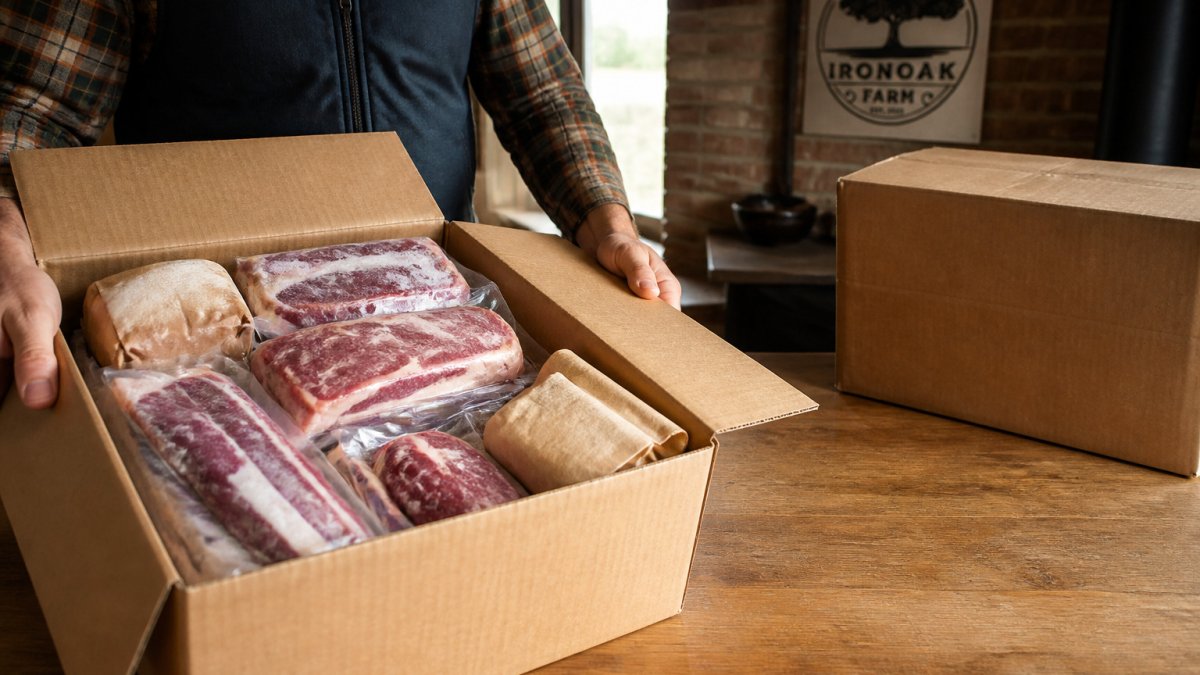
At Iron Oak Farm, we raise, grow and butcher our own livestock, slaughter by an ethical abattoir (4333), and produce artisan deli items including gluten and lactose-free options for households managing intolerances. That means complete transparency from birth to plate, high animal welfare standards, and meat grown locally rather than shipped through a chain of intermediaries.
Frequently Asked Questions
What are the benefits of buying meat directly from a farm?
Buying direct from a farm shortens the supply chain and gives you a named source for every cut. You can ask how the animals were raised, what they were fed and how slaughter was handled, which is far harder to confirm through a supermarket. Direct buying also supports small-scale farming and local food systems, and many families find the meat keeps better and tastes fuller because it has not travelled far. Ask the farm about traceability and whether you can visit before committing.
What does fully traceable mean when buying meat?
Fully traceable means the seller can document an animal's journey from birth through rearing, slaughter and butchery to the cut in your hands. In practice, you should be able to ask which farm the animal came from and get a straight answer. Farms that oversee the whole process, including on-site licensed slaughtering, can usually provide this detail because nothing is outsourced. Traceability is the backbone of supply chain transparency and the best defence against vague welfare marketing.
How does local meat sourcing reduce a family's carbon footprint?
Shorter journeys from farm to plate mean less transport and refrigeration, which lowers the carbon footprint attached to each cut. Buying whole or larger cuts and using the whole animal also cuts waste, and waste is a major part of food emissions. Local sourcing is not the whole answer, but combined with eating less meat of better quality, it makes a measurable difference for a family.
Is ethical meat more expensive, and how do families budget for it?
It often costs more per kilogram because high-welfare farming is slower and smaller in scale. The practical answer is to buy less but better: choose cheaper cuts such as shoulder, shin and mince, buy larger joints and freeze portions, and plan meals around seasonal availability. Many farms offer box schemes or regular orders that bring the cost per meal down. Ask the farm directly about pricing, as it depends on quantity, dates and delivery.
If you are ready to move from reading labels to knowing your producer, start with a farm you can question directly. Get started with Iron Oak Farm and browse our full range of fully traceable meat and deli produce, shop our fresh meat range today.
Comments